Alaska State Guide
Aboveground Storage Tank Requirements in Alaska
A buyer's overview of SPCC, ADEC spill prevention, and permitting considerations for aboveground fuel tanks in Alaska — before you specify a system.
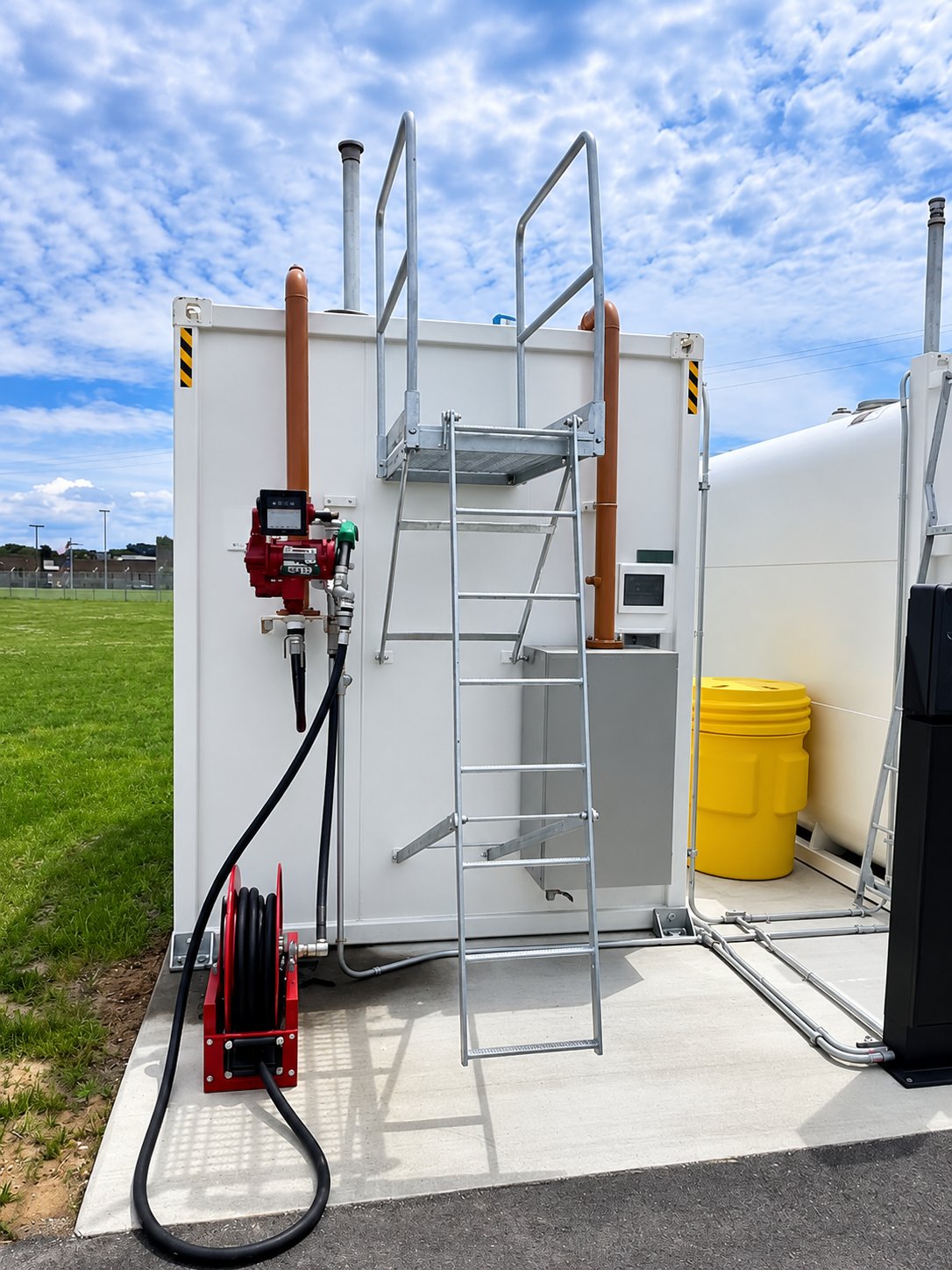
Alaska regulates ASTs in three distinct size tiers
Alaska's structure is worth understanding precisely, since it differs from the pattern in most of your other states — and one detail matters enough to flag directly: Alaska DEC (ADEC) oversight applies at the largest end of the size range, not the smallest. Tanks under 1,000 gallons generally aren't DEC-regulated. Tanks between 1,000 and 420,000 gallons of refined product sit in a middle tier where DEC's own facility-level enforcement (formerly covering "Class 2 Facility" tanks in that range) has not been enforced since May 2021 and has since been repealed. Only facilities with an effective storage capacity of 420,000 gallons (10,000 barrels) or more of refined petroleum, or over 210,000 gallons of crude oil, fall under direct ADEC regulation, per Alaska Administrative Code Title 18, Chapter 75.
That doesn't mean mid-size tanks in Alaska are unregulated — it means the applicable framework shifts. Tanks with aggregate storage capacity greater than 1,320 gallons (counting every container 55 gallons or larger) are regulated by the EPA under the federal SPCC rule and by the State Fire Marshal, not by ADEC directly. Notably, Alaska's SPCC plans must be signed by a registered engineer and kept on-site — a state-specific documentation requirement worth building into your compliance timeline.
Fire code & remote logistics considerations
Independent of the size-tiered spill program, most AST installations are also regulated under NFPA 30 (and NFPA 30A for fueling operations), adopted through the Alaska Fire Code, with tank listing (UL 142), containment, and setback review handled by the State Fire Marshal's Office or a local jurisdiction with deferred authority, depending on location. Remote sites add practical constraints that don't come up in the Lower 48 states in your territory — barge or air freight lead times that can run months rather than weeks, and seismic anchoring design considerations in many regions — which makes early tank specification and ordering especially important on any Alaska project timeline.
Rural bulk fuel farms — a distinct category
A meaningful share of Alaska's AST activity is rural community bulk fuel storage, which ADEC treats as its own category with dedicated resources — including an Aboveground Storage Tank Operator Handbook and operator training historically supported through the Alaska Energy Authority and the Denali Commission. Funding for tank farm upgrades in rural communities is available through those same organizations, which is worth knowing when you're scoping a project for a village or remote-community buyer rather than an industrial site on the road system.
Regardless of tank size or tier, all releases of petroleum product into the environment must be reported to ADEC by law — this reporting obligation applies even to tanks that fall outside DEC's direct facility regulation.
Common mistakes we see in Alaska projects
Assuming ADEC directly regulates any tank over a low threshold — in practice, ADEC's direct facility oversight only kicks in at 420,000+ gallons refined (or 210,000+ crude); mid-size tanks fall to federal SPCC and the State Fire Marshal instead.
Underestimating freight lead times for remote or off-road-system sites, resulting in a compliant tank spec that can't physically arrive on the project's timeline.
Skipping seismic anchoring design review, which many Alaska jurisdictions expect beyond baseline NFPA 30 siting requirements.
Typical permitting process
Confirm applicability — determine which tier your facility falls into: federal SPCC, State Fire Marshal, or direct ADEC regulation at 420,000+ gallons.
Site & tank design review — siting, seismic anchoring, secondary containment, UL 142 double-wall construction.
Freight & logistics planning — barge or air freight lead times factored into the project schedule well ahead of the installation window.
Permit submission — application to the State Fire Marshal (or deferred local jurisdiction) and ADEC where applicable.
Inspection & commissioning — final inspection, tank commissioning, and SPCC plan certification (engineer-signed, kept on-site).
Requirements vary by facility type, tank capacity, and region. Confirm current thresholds with ADEC's Spill Prevention and Response Program and the State Fire Marshal's Office.
Quick Facts — Alaska
Environmental Agency
Alaska DEC (ADEC) — direct oversight at 420,000+ gal
Fire Code
Alaska Fire Code (NFPA 30/30A)
Mid-Tier Tanks (1,000-420,000 gal)
Federal SPCC + State Fire Marshal, not direct ADEC
Notable
Engineer-signed SPCC plan kept on-site; seismic anchoring in many jurisdictions
Regional Demand Drivers
Oil & gas support, remote communities, marine/fishing operations
Sourcing a tank for an Alaska facility?
Get sizing options and compliance guidance specific to your site below.
Request a Quote
Get Alaska-specific tank guidance
We'll follow up with sizing options, lead times, and compliance guidance for your site.
FAQ
Alaska AST FAQ
Does the federal SPCC threshold apply the same way in Alaska?
The federal 1,320-gallon aggregate threshold applies as it does elsewhere. ADEC's own direct facility regulation only kicks in at a much higher tier — 420,000+ gallons of refined product or 210,000+ gallons of crude — so mid-size tanks fall to federal SPCC and the State Fire Marshal rather than ADEC directly.
How does remote location affect tank sourcing?
Barge and air freight lead times can be significantly longer than the Lower 48 — plan tank ordering well ahead of your installation window.
Are seismic requirements different for Alaska tanks?
Many Alaska jurisdictions require seismic anchoring design considerations beyond standard NFPA 30 siting — confirm with your local fire marshal.
Is my rural community bulk fuel tank regulated differently?
Rural bulk fuel storage is treated as its own category, with operator training and upgrade funding historically available through the Alaska Energy Authority and Denali Commission alongside standard SPCC/fire code requirements.
Do I need to report a spill even from a small AST?
Yes. All releases of petroleum product into the environment must be reported to ADEC by law, regardless of tank size or regulatory tier.